News
New manuscript by Robert Walser
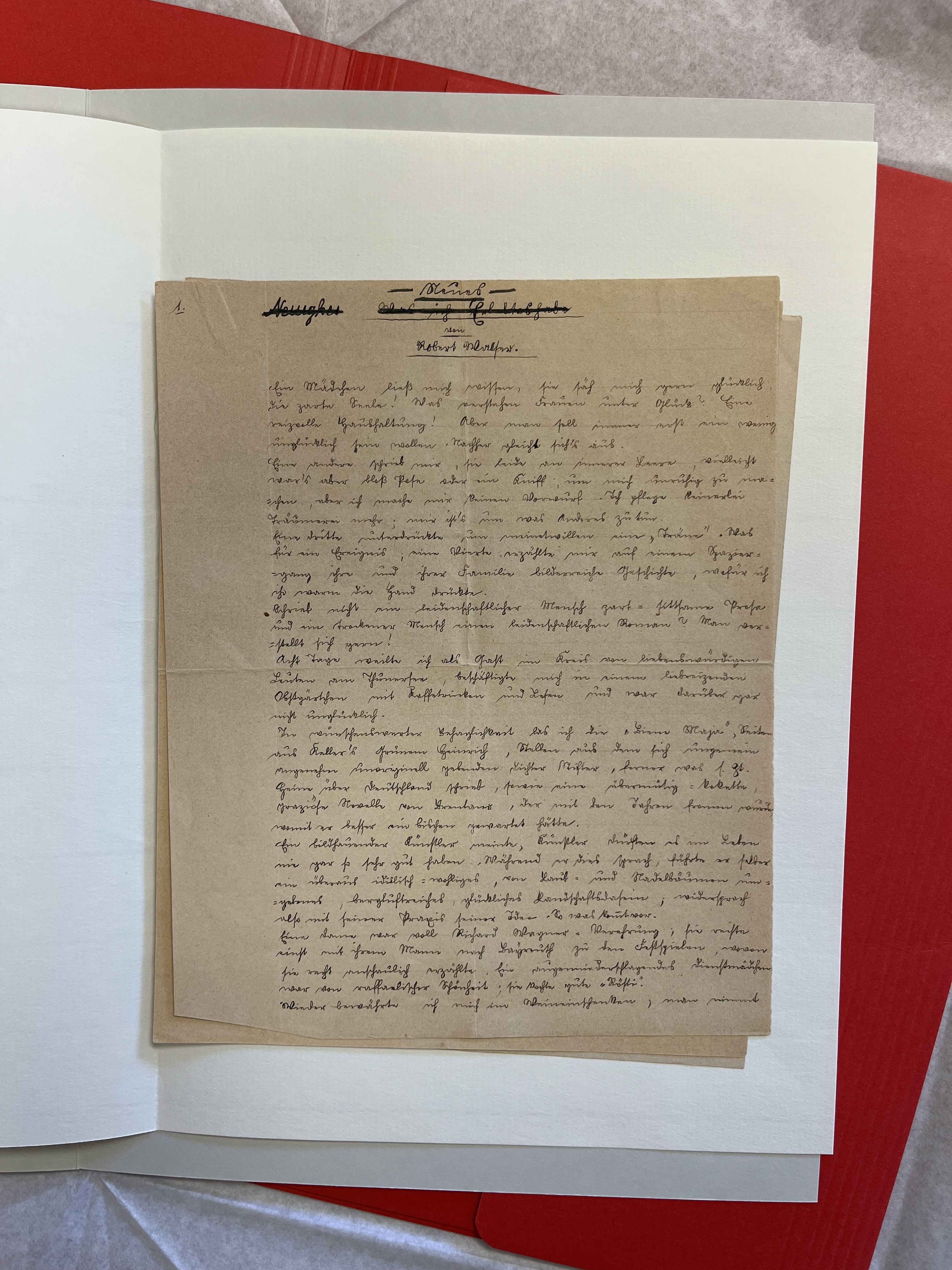
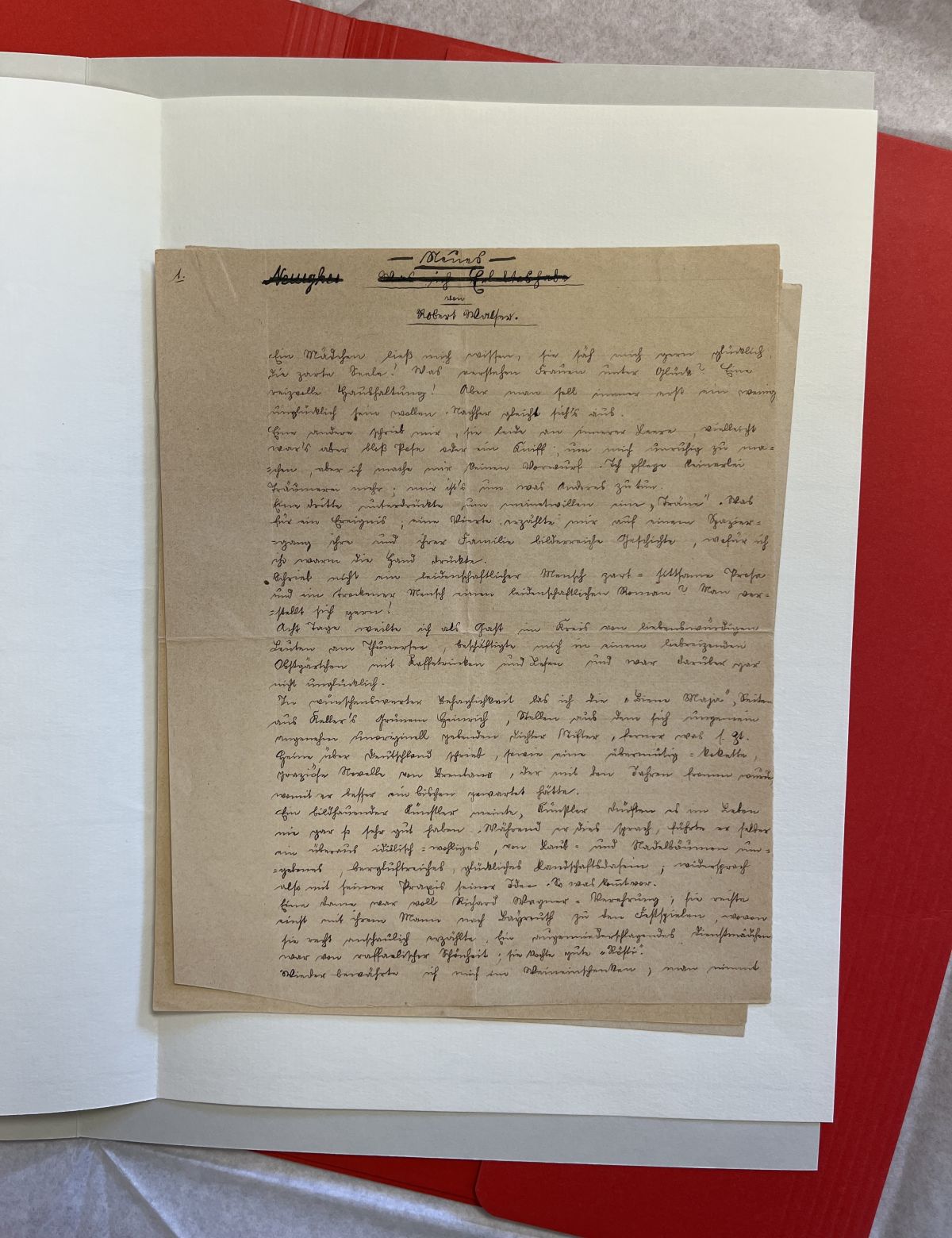
The Robert Walser Foundation in Bern has acquired a manuscript that was previously not accessible. The title of the manuscript is, literally, ‘Neues’. The Robert Walser Centre is making it accessible to the public and researchers.
The writer Robert Walser (1878–1956), born in Biel, had been living in Bern since 1921. To earn a living, he wrote numerous articles for newspapers and magazines. In 1921, he sent the article ‘Neues’ to the editor of the magazine ‘Der neue Merkur’. The text was not published at the time. The manuscript passed through various private hands and was inaccessible.
“This acquisition provides valuable insights for both researchers and the general public,” says Marcel Lepper, director of the Robert Walser Centre. “The manuscript reveals Walser to be a meticulous participant and observer. At the same time, it illustrates just how vibrant and fragile the network of periodicals was in the 1920s.”
Original and Back
Due to the limited availability of sources, the text was published decades ago by the Walser scholar Jochen Greven. He referred to an owner in Liestal who had enabled him to reproduce it. The original manuscript, which has now been acquired by the Robert Walser-Stiftung Bern, allows for a more accurate reconstruction. On the reverse of the third page, Walser writes to the editor of the magazine ‘Der neue Merkur’:
“Dear Mr Frisch, if you can publish this, I shall be delighted. Best regards, / Robert Walser / Bern, / Manuelstraße 72.”
Walser repeatedly crossed out the title of the play. Initially, it read: ‘What I Have Experienced’, ‘Experiences’, ‘News’. The prose text begins with the lines
“A girl let me know she’d like to see me happy – what a tender soul!”
Is it the author Robert Walser speaking here? Later, on the subject of biographical misinterpretations, he writes:
“Didn’t a passionate person once write tender, demure prose, and a dry person a passionate novel? People like to put on a front!”
The ‘Der neue Merkur’ and its editor
The editor of the monthly magazine ‘Der neue Merkur’, the writer Efraim Frisch, born in 1873, came from Stryj. The town is situated in what is now western Ukraine. After abandoning his rabbinical training, Frisch studied in Vienna and Berlin. He established his magazine in Munich. ‘Der neue Merkur’ was published at irregular intervals between 1914 and 1925.
The journal ‘Der neue Merkur’ features prominent figures from the literary and philosophical modernist movement: Lou Andreas-Salomé, Ernst Bloch, Martin Buber, Alfred Döblin, Annette Kolb, Heinrich Mann, Thomas Mann, Christian Morgenstern, Frank Wedekind, Regina Ullmann – and Robert Walser. Despite occasional disputes, Walser contributed to the journal from its first to its final volume, with works including ‘Sebastian’ (1914), ‘Reisebeschreibung’ (1915) and ‘Schreiben an ein Mädchen’ (1920).
The Journey of the Manuscript
Even during Walser’s lifetime, letters and manuscripts were being offered on the autograph market. The history of the manuscript ‘Neues’, which remained inaccessible for a long time, is particularly complex. In 1925, the magazine ‘Der neue Merkur’ ceased publication. In 1933, Efraim Frisch fled to Switzerland to escape Nazi persecution. Robert Walser was admitted to the Herisau sanatorium in the same year.
Frisch died in Ascona in 1942. On 3 November 1943, an auction took place in Zurich, in which the Zurich-based antiquarian bookshop Schumann and the Geneva-based antiquarian bookshop Kundig took part. The Zurich auction catalogue of 3 November 1943 lists the Walser manuscript ‘Neues’ under lot number 93.
The owner, to whom Jochen Greven referred in his 1966 edition of Walser’s works, was the antiquarian Mario Uzielli (1888–1973). He had run an art dealership in Frankfurt am Main and, classified as a so-called ‘half-Jew’ and married to a Jewish woman, had emigrated to Switzerland in 1938. Forced to part with his Frankfurt inventory, he had resumed his business in Liestal.
In 1976, the piece was sold again at an auction held by the Berlin autograph dealer Stargardt. From there, in 1978, it almost found its way into the exhibition marking the 100th anniversary of Walser’s birth at the Helmhaus in Zurich. It subsequently changed hands again in 2010 and 2017, until it was recently acquired by the Robert Walser-Stiftung Bern.
The research tasks include reconstructing the provenance – the journey the Walser manuscript has undertaken from Bern since 1921 – before it returned to Bern in 2026 via numerous stopovers.
The Foundation’s and the Centre’s mission
The Robert Walser Foundation is dedicated to researching and promoting the works of Robert Walser. The Bernese Edition is being published by Suhrkamp Verlag. The Centre, which is supported by the Foundation, works successfully with the Swiss Literary Archives within the framework of the Bern Model.
Manuscripts and letters by Robert Walser are regularly discovered on the autograph market. The Robert Walser Foundation regards the preservation of this legacy for research and the public as the core task of its collecting activities. New acquisitions are presented at the Robert Walser Centre in the autumn.
For holidaymakers and anyone interested, the Centre provides a digital map to explore the various places in Bern where Robert Walser lived. This includes Manuelstrasse 72, Walser’s address at the end of 1921.
Contact
Robert Walser Centre – Director: Prof. Dr Marcel Lepper – marcel.lepper@robertwalser.ch
Image
Robert Walser: ‘Neues’. © Robert Walser-Stiftung Bern.
Press release PDF (download, in German)